Best Fishing Kayaks: 5 Picks From Budget to Pedal Drive
Safety note: Wear a U.S. Coast Guard-approved life jacket every time you paddle; federal rules require one wearable life jacket...
 By James
Updated November 10, 2026
Safety note: Wear a U.S. Coast Guard-approved life jacket every time you paddle; federal rules require one wearable life jacket per person on a kayak, and children under 13 must wear one while underway unless state rules differ. Stay within the kayak’s weight capacity, dress for the water temperature, check the weather, and tell someone your plans. See our fishing safety tips.
A fishing kayak lets you reach water that boats and bank anglers cannot, quietly and for a fraction of the cost of a boat. Most fishing kayaks are sit-on-top designs: stable, self-bailing, easy to get back on, and roomy for crates and rods. The big choices are paddle or pedal, how much stability you need (especially if you want to stand), length, and how much weight you can lift onto a car.
This guide compares five sit-on-top fishing kayaks from Pelican, Old Town, Perception, and Lifetime. We compared each maker’s published length, weight, capacity, hull, seat, propulsion, and fishing features. For accessories, see our kayak paddles, kayak PFDs, and kayak anchor systems guides.
Our Top Picks
| Best for | Product | FH Score About FH ScoreThe FH Score is our editorial rating from 0 to 10, based on published specs, materials, warranty and value. It is not based on Amazon ratings and is never influenced by commissions. Learn more › | |
|---|---|---|---|
| Best overall |
 Pelican Catch Mode 110 |
8.2/10 | Check Price |
| Best pedal kayak |
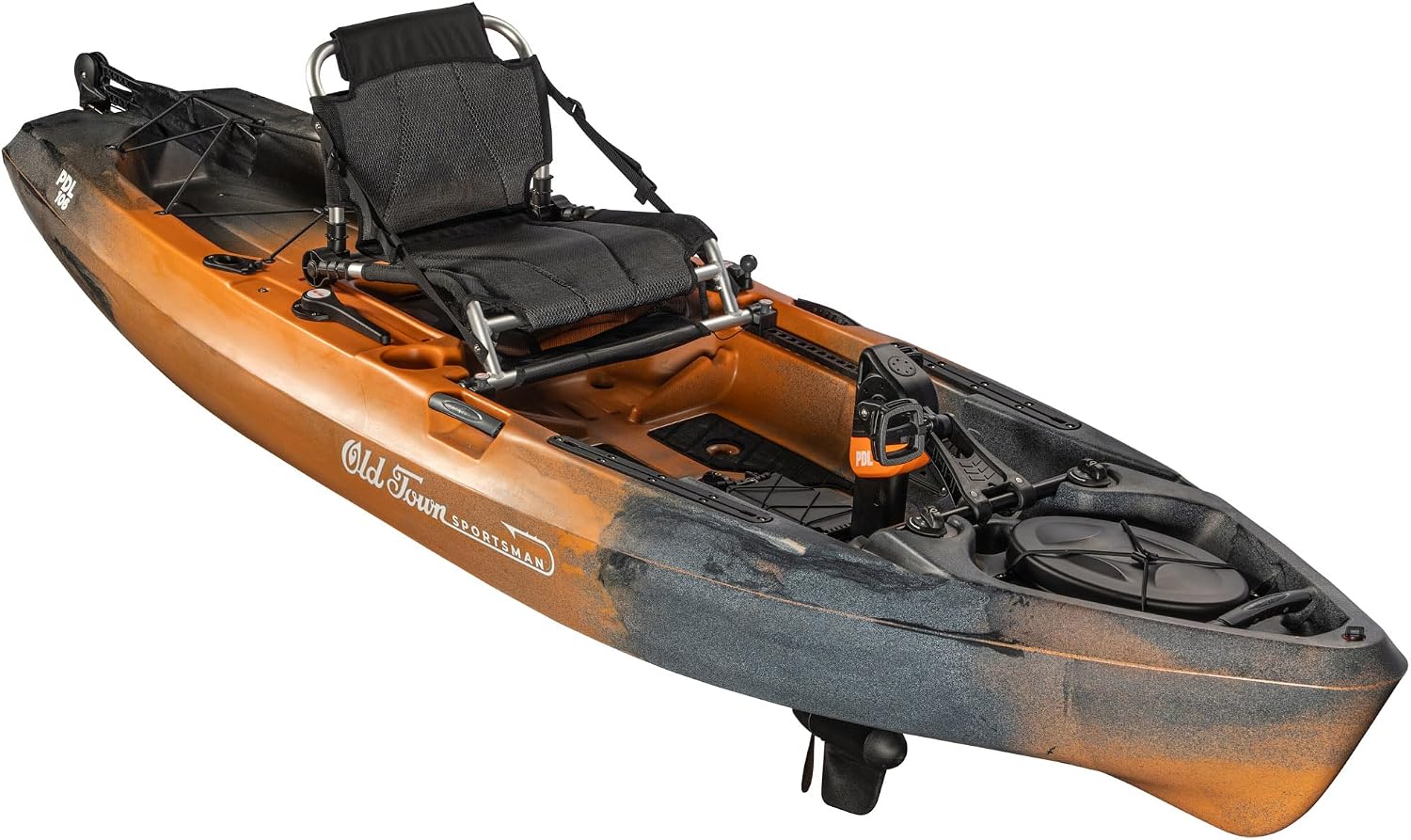 Old Town Sportsman PDL 106 |
8.3/10 | Check Price |
| Best for stability and storage |
 Perception Outlaw 11.5 |
7.9/10 | Check Price |
| Best for beginners |
 Perception Pescador Pro 10 (with Scupper Plugs) |
7.6/10 | Check Price |
| Best budget |
 Lifetime Tamarack Angler 100 |
7.2/10 | Check Price |
The Picks in Detail
Pelican Catch Mode 110
Why it made the list: The Catch Mode 110 balances stability, features, and weight. Its tunnel hull and wide, flat deck are designed for standing to cast, and at 63 lb and 10’8″ it is light enough for many anglers to load alone. It has an adjustable ERGOBOOST seat with under-seat storage, two 4-inch accessory tracks, three flush-mount rod holders, front and rear tank wells, and a non-slip deck pad. Pelican adds extra flotation in the hull to meet or exceed ABYC standards, per the maker.
Key specs: 10 ft 8 in; 63 lb; 375 lb maximum capacity; tunnel hull; standing platform; ERGOBOOST adjustable seat with EVA pad; two 4 in accessory tracks; three flush-mount rod holders; front and rear tank wells; two bottle holders; anti-slip deck; high molecular weight polyethylene.
Skip it if: you want hands-free propulsion. The Old Town Sportsman PDL 106 has a pedal drive.
Pros
- Light for a stand-up fishing kayak
- Good fishing features for the price
- Comfortable adjustable seat
Cons
- 375 lb capacity limits larger anglers with heavy gear
- Paddle only, no pedal option
Old Town Sportsman PDL 106
Why it made the list: A pedal drive frees your hands to fish while you hold position or move along a bank. The Sportsman PDL 106 has a forward and reverse pedal drive with an easy-docking design, a stable pontoon-style hull, a mesh seat with lumbar support that adjusts to leg length, accessory tracks, rod holders, a tackle box, and a universal transducer mount for a fish finder.
Key specs: 10 ft 6 in; 107 lb kayak plus 18 lb removable pedal console; 450 lb maximum capacity (343 lb usable for people and gear); pontoon-style hull; forward and reverse pedal drive; mesh seat; accessory tracks; universal transducer mount; paddle sold separately.
Skip it if: you must lift your kayak onto a tall vehicle alone. A lighter paddle kayak is easier.
Pros
- Hands-free pedal drive with reverse
- Stable hull
- Ready for a fish finder
Cons
- Heavy to load and carry
- Expensive
Perception Outlaw 11.5
Why it made the list: The Outlaw 11.5 is built for anglers who carry a lot of gear. It has a 425 lb capacity, a large rear tankwell for a crate or cooler, a front storage area, four rod holders, and integrated tackle trays. The fold-away frame seat makes room to stand, and it is made in the USA.
Key specs: 11 ft 6 in; 425 lb capacity; fold-away frame seat; four integrated rod holders; integrated tackle trays; large rear tankwell; front storage; made in USA.
Skip it if: you paddle long distances. A narrower kayak moves more efficiently.
Pros
- High capacity
- Lots of storage
- Stable, standing-friendly design
Cons
- Kayak weight not stated on the listing
- Longer and wider kayaks are slower to paddle
Perception Pescador Pro 10 (with Scupper Plugs)
Why it made the list: Perception calls the Pescador Pro a first fishing kayak, and it is a sensible, simple choice. It is made in the USA with one-piece, leak-proof construction and built-in buoyancy, a breathable lawn-chair mesh seat with two height positions, and large open storage front and rear. This listing bundles four scupper plugs for drier rides in cold water.
Key specs: 10 ft 6 in; one-piece construction with built-in buoyancy; mesh lawn-chair seat with two-level adjustment; large front and rear open storage; made in USA; bundle includes 4 scupper plugs (fit 1 to 1-3/8 in holes).
Skip it if: you want accessory tracks and lots of rod holders out of the box. The Pelican Catch Mode 110 has more.
Pros
- Simple, durable design
- Comfortable raised seat
- Scupper plugs included
Cons
- Capacity and weight not stated on the listing
- Fewer rod holders and tracks than the Pelican
Lifetime Tamarack Angler 100
Why it made the list: The Tamarack Angler is a low-cost 10-foot fishing kayak that comes with a paddle. It has a stable flat bottom, a padded seat back and pad, two flush-mount and one top-mount rod holder, two 6-inch storage hatches, multiple footrest positions, and a skeg and tracking channels to help it paddle straight.
Key specs: 10 ft; UV-protected high-density polyethylene; flat bottom; padded seat back and pad; three rod holders; two 6 in storage compartments; skeg and tracking channels; front and rear T-handles; paddle included.
Skip it if: you fish all day or want to stand. A kayak with a framed seat and wider deck is more comfortable.
Pros
- Low cost
- Paddle included
- Stable for calm water
Cons
- Basic seat compared with framed seats
- Capacity and weight not stated on the listing
Fishing Kayaks Compared
| Kayak | Length | Weight | Capacity | Propulsion |
|---|---|---|---|---|
| Pelican Catch Mode 110 | 10 ft 8 in | 63 lb | 375 lb | Paddle |
| Old Town Sportsman PDL 106 | 10 ft 6 in | 107 lb + 18 lb drive | 450 lb (343 usable) | Pedal |
| Perception Outlaw 11.5 | 11 ft 6 in | Not stated | 425 lb | Paddle |
| Perception Pescador Pro 10 | 10 ft 6 in | Not stated | Not stated | Paddle |
| Lifetime Tamarack Angler 100 | 10 ft | Not stated | Not stated | Paddle (included) |
How We Picked
We did not paddle these kayaks for this guide. We researched each one and compared the specifications published by the makers. Our criteria:
- Stability for fishing and, where offered, standing.
- Capacity and weight, including how hard it is to load.
- Seat comfort for long days.
- Fishing features: rod holders, tracks, storage, transducer mounts.
- Value from budget to pedal-driven.
The FH Score in each product box is our editorial rating, built from five weighted criteria: performance for the job, build quality, versatility, warranty and value. It is not based on Amazon ratings. See how it works on our How We Review page.
How to Choose a Fishing Kayak
Sit-on-top vs. sit-inside
Most fishing kayaks are sit-on-top: they are stable, drain through scupper holes, and are easy to climb back onto. Sit-inside kayaks are warmer and drier in cold weather but harder to re-enter.
Paddle vs. pedal
Paddle kayaks are lighter and cheaper. Pedal kayaks free your hands and are easier to hold in wind, but they cost and weigh much more.
Length and width
Kayaks around 10 to 11 feet are easier to carry and turn. Longer kayaks track straighter and go faster. Wider kayaks are more stable but slower.
Capacity
Add your weight, gear, cooler, and crate, and stay well under the stated capacity for good handling.
Transport and storage
Check the kayak’s weight against what you can lift onto your vehicle. A cart helps at the launch.
Related Guides
- Best Kayak Paddles for Fishing
- Best PFDs for Kayak Fishing
- Best Kayak Anchor Systems
- Best Trolling Motors
See more in our Fishing Kayaks section.
FAQ
What size fishing kayak should I get?
About 10 to 12 feet suits most anglers on lakes and rivers. Choose longer for big water and long paddles.
Can you stand in a fishing kayak?
In kayaks designed for it, like the Pelican Catch Mode 110 and Perception Outlaw 11.5. Practice in calm, shallow water first and wear your life jacket.
Is a pedal kayak worth it?
If you fish in wind or current or want both hands free, many anglers find it worth the cost and weight.
Do I need anything else to start kayak fishing?
A life jacket, a paddle (if not included), a way to carry the kayak, and a crate or rod holders. An anchor and leash help too.
Final Thoughts
The Pelican Catch Mode 110 is our top pick for its stable, stand-up design, fishing features, and light weight. Choose the Old Town Sportsman PDL 106 for hands-free pedaling, the Perception Outlaw 11.5 for capacity and storage, the Perception Pescador Pro 10 for a simple first kayak, and the Lifetime Tamarack Angler 100 on a tight budget.
About the author
James writes reviews and buying guides for Fishing Hacking, covering rods, reels, line, lures, and the gear anglers rely on. His work focuses on clear criteria, balanced pros and cons, and practical advice to help readers choose equipment that fits how and where they fish.